10/20/2026
BUILDING WITHOUT DATA LOSS
Moritz Luck and Florian Marthaler Want to Move the Construction Industry to an Open Platform
The use of software such as Revit, ArchiCAD, and AutoCAD is indispensable in the construction industry, yet it is also the root of a costly problem. Architects design a building in one program, then export it to a standardized file format such as IFC and pass the data on to the structural engineering team. There, information that the next program cannot carry over has to be added manually. The same process repeats during regulatory reviews. Building data thus moves from one system to another, requiring constant adjustments or reentry.
Data is lost whenever software lacks the depth needed for a particular task: a code compliance module that does not recognize local building codes; a cost estimator that does not support a company's own tendering format; a configurator that cannot represent a proprietary building system. The result is always the same: an export. And with every export, relationships break, versions disappear, and models lose their meaning. This is not just cumbersome; it is expensive. An industrial general contractor that designs and builds structures from prefabricated components submits an average of twenty bids before winning a contract. Each bid requires three to four weeks of work. One reason is that the same data must be entered repeatedly into multiple tools.
This is precisely where Moritz Luck and Florian Marthaler come in. Moritz had already built and sold a software company in the construction industry. After the exit, he became an investor and focused on three fields he considered particularly promising for the future: climate, artificial intelligence, and construction. This led him to Florian Marthaler, who co-builds startups through his venture builder. The longer the two worked together, the clearer the enormous potential became. Moritz became a founder again, with Florian as his co-founder. What unites them is their conviction that the 35 percent of data lost at every interface is not inevitable, but a design flaw.


The obvious answer would be a better tool. Moritz and Florian see it differently. What if the problem lies not in any individual system, but in the underlying concept itself? What if, instead, you built a platform that eliminates the need for exports because every discipline, from architectural design and structural engineering to tendering, works from the same data model?
As part of a validation assignment from SPRIND, the two founders and their team are investigating a crucial question: How must the data in a building model be structured to remain usable across a wide range of use cases? This applies equally to an AI system that needs to understand a building semantically and to architects, structural engineers, and building inspectors, each of whom needs only part of the information. The answer is more than a technical detail. It will determine whether the data model becomes a shared foundation on which AI and people can work on the same building, or simply the next file format from which everyone has to export their data all over again.
The four layers of an open platform
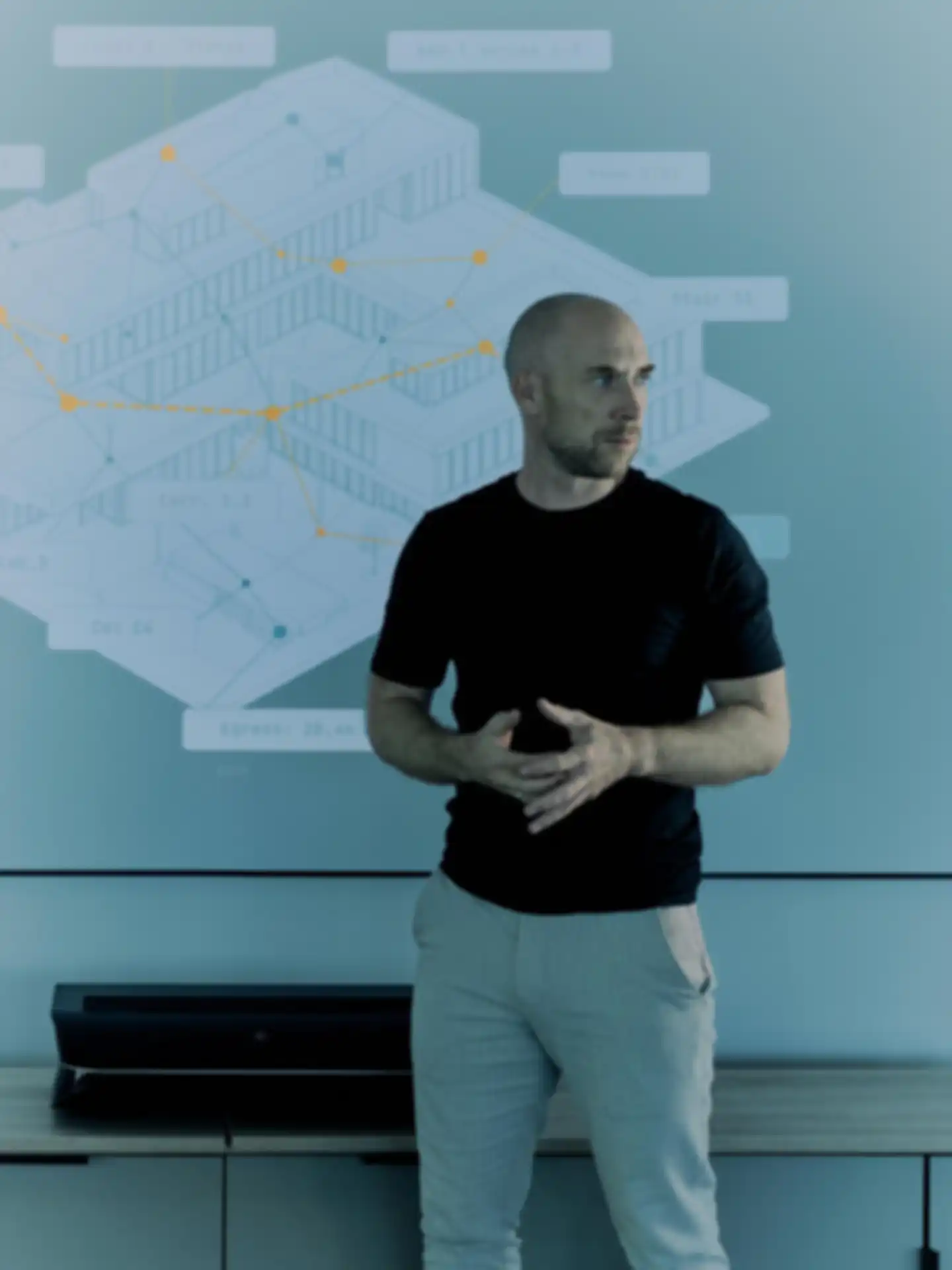
The open platform Moritz and Florian are building is called buildOS. It is not another tool like Revit or Enscape, but an infrastructure on which other tools can be built. To achieve this, buildOS uses four layers:
The bottom layer is the Geometry Kernel. It provides the fundamental mathematical functions required for digital building design, such as combining digital building components or checking their shape and position. Other applications can access these functions through an open programming interface known as an API. Built on top of this is the Data Graph. It represents buildings as a connected data model, storing not only geometry but also the relationships between rooms, building components, contracts, and regulations. A wall is therefore more than just a digital cuboid. The system can also represent which fire safety requirements it meets, which lease agreement it is associated with, or which trade is responsible for manufacturing it. The third layer is the AI Harness. It enables modern AI models to understand and work with buildings as structured data, rather than merely as images or plans. To do this, the AI is equipped with the necessary functions, a defined planning workflow, and the ability to check its results against applicable rules. This transforms a general-purpose AI model into a specialized agent for construction planning. Finally, the Gateway allows external providers to integrate their own functionality. This can include structural analysis and verification tools, product catalogs, or cost calculations. Once integrated, these functions can also be called directly by the AI.
The result is an open infrastructure that allows different applications and components to work together. buildOS does not aim to build every individual tool itself. Instead, it provides the digital workbench on which the industry can develop its own tools and connect them to one another.
Canvas and Marketplace
To make this possible, buildOS is developing two ways to interact with the platform. Power users can connect data sources, calculations, checks, and visualizations into custom workflows on an infinite canvas, an unlimited visual workspace. Those who do not want to dive that deep can control the same processes through a natural-language chat interface. The platform also includes a marketplace for specialized expertise. An architect, for example, can offer a ready-to-use tool for checking regional building codes, while a manufacturer can provide its building system complete with dimensions and connection rules. Others can use these components directly and build on them.


The potential: an industry without export-related data loss
buildOS is not just a concept on paper; it can already be tested today. Major customers in areas such as prefabricated construction and real estate development are currently putting the platform through its paces in real-world applications.
The market potential is correspondingly large. According to the team, the market is worth around $1.3 trillion. What is missing today is a shared infrastructure that connects the industry's different tools and data sources. Whoever fills this gap stands to benefit from a self-reinforcing cycle: the more people contribute their components, the more data becomes available. More data, in turn, can improve the AI. Better AI attracts more users. The better this system works, the less often data will need to be exported, until what is now a cumbersome everyday necessity eventually becomes the exception.

More Magazine Articles