




Apply now

Your Challenge:
Next Frontier Robotics

Hello, innovators! We need technological breakthroughs to unlock the next S-curve of multi-purpose robotics made in Europe. We need bold approaches and the ambition to move from demos to real-world impact. We need you.

While robots today master repetitive tasks in controlled settings, they still fundamentally struggle with novel tasks, changing conditions or unstructured environments. Widening demographic shifts, a growing labor shortage, and rising competitiveness urgently drive the need for robotics systems that can tackle physical tasks reliably while safeguarding safety and sovereignty.

Global competitors in the US and China are investing billions into closed robotics systems, placing Europe at risk of strategic dependence without its own frontier innovations. While Europe retains a world-class manufacturing foundation and research footprint, shaping the next era of robotics demands immediate action to scale next-generation hardware and the intelligent systems to operate them. The SPRIND Challenge Next Frontier Robotics accelerates this leap by backing exceptional teams with moonshot approaches that move beyond incremental optimizations to deliver true capability leaps.

Together, we are building a modular, interoperable European robotics ecosystem ready to adapt to the complexity of real-world tasks.

Allow data transfer to/from vimeo.com? (learn more)

The Challenge: Develop full-stack robot platforms that handle complex physical tasks in real environments or novel robotic hardware components with breakthrough capabilities.

The challenge covers two complementary paths: Track 1 ‘Integrated Platforms’ challenges teams to orchestrate sub-components into complete multi-purpose robots which can tackle complex, commercial use cases. Track 2 ‘Hardware Components’ focuses on novel hardware such as gripping systems, sensors, or joints that achieve a radical performance leap over the state of the art.

Both tracks start by separately testing their approaches in lab environments (Stage 1) prior to moving into the real world (Stage 2), then focus on integration and interoperability into one system (Stage 3) before working on interoperability between different systems (Stage 4). As the challenge progresses, teams are expected to collaborate with complementary challenge participants or external partners to foster the development of standards. This sets the foundation for an interoperable ecosystem, enabling teams (and later customers) to tackle their selected use cases with the best-suited hardware and models under actual operating conditions, moving robotics from the lab into real-world scenarios.

The primary focus is on terrestrial, physically interactive applications in industrial and societal settings such as logistics, care support and construction.

We support: Potential breakthrough innovations

The challenge runs for 36 months across four sequential stages. A jury of recognized experts supports SPRIND in selecting and evaluating participating teams. SPRIND provides financial backing as an individual fixed-price contract based on the team's cost estimate, offering up to €7,200,000 per team.

Beyond funding, SPRIND provides continuous venture development support, coaching, and direct access to new collaboration partners, first customers, and potential investors. Where significant potential for breakthrough innovation is identified, SPRIND may continue providing financial support even after the challenge ends.

SPRIND’s mandate is to support technology transfer. Therefore, teams shall aim to incorporate a company, ideally before the challenge starts and show commitment to build an eventually self-sustaining business.

Jury

A portrait photo of Professor Albu-Schaeffer, smiling slightly against a background of blurred branches

Prof. Dr. Alin Albu-Schäffer

Europe will lose 20 million people as a workforce in the next decade due to demographic change. Compensating at least half of them with robots is a huge challenge, and will be essential for ensuring our welfare. We need to make sure that robots will be trustable helpers, according to our values and the needs of our society.
Read full Article
A portrait of Lukas Ziegler against a blurred background, looking to the side.

Lukas Ziegler

Right now robotics is moving from demos to real deployments, and whoever builds the core technology in the next few years will set the rules for the next few decades. A challenge like this gives European teams a way to compete on ambition, not only on budget.
Read full Article
A full-body portrait of Andreas Klinger, leaning with his back against a gray wall covered with colorful letters. One leg is bent, and both hands are in his jacket pockets.

Andreas Klinger

In the next 3 years we will have auto-complete for the real world. You do a task, press a button, the robot steps in and repeats the task. This alone will enable all kinds of new small businesses.
Read Full Article
A portrait photo of Christopher Kränzler, standing in front of a plain wall and smiling at the camera. He is wearing a down vest, and the photo is bathed in a greenish light.

Christopher Kränzler

Following Next Frontier AI Challenge, Next Frontier Robotics is SPRIND's second biggest challenge with 90M€. It is the next logical step in bringing AI into the physical world moving us one step closer to SPRIND's mission to establish the next-generation, full stack AI and Robotics paradigm out of Europe.

The Competition

Detailed information can be found in the call for submission and the participation agreement.

Application

The application period runs until October 22, 2026, at 18:00 (CEST). All applications submitted by this deadline will be considered.

Applicants applying to both tracks must submit a separate application form for each. This ensures an independent review process, as candidates may advance in one track without advancing in the other.

Webinar

Webinar Next Frontier Robotics Challenge

IP Provisions in the SPRIND Challenge Programme – What You Need to Know:

FAQ

Do you have any questions about the challenge? Write to us at challenge@sprind.org.

Jano Costard, Head of Challenges

More about this topic

Podcasts

#135 Christopher Kränzler (21.9.2026)

48:33

Wie nützlich sind humanoide Roboter? Was passiert, wenn KI und Robotik miteinander verschmelzen? Und welche Ziele hat die SPRIND mit der Next Frontier Robotics Initiative? Unser Host Thomas Ramge spricht mit Christopher Kränzler, KI-Gründer und SPRIND-Robotik-Experte.

Magazine Articles

9/23/2026

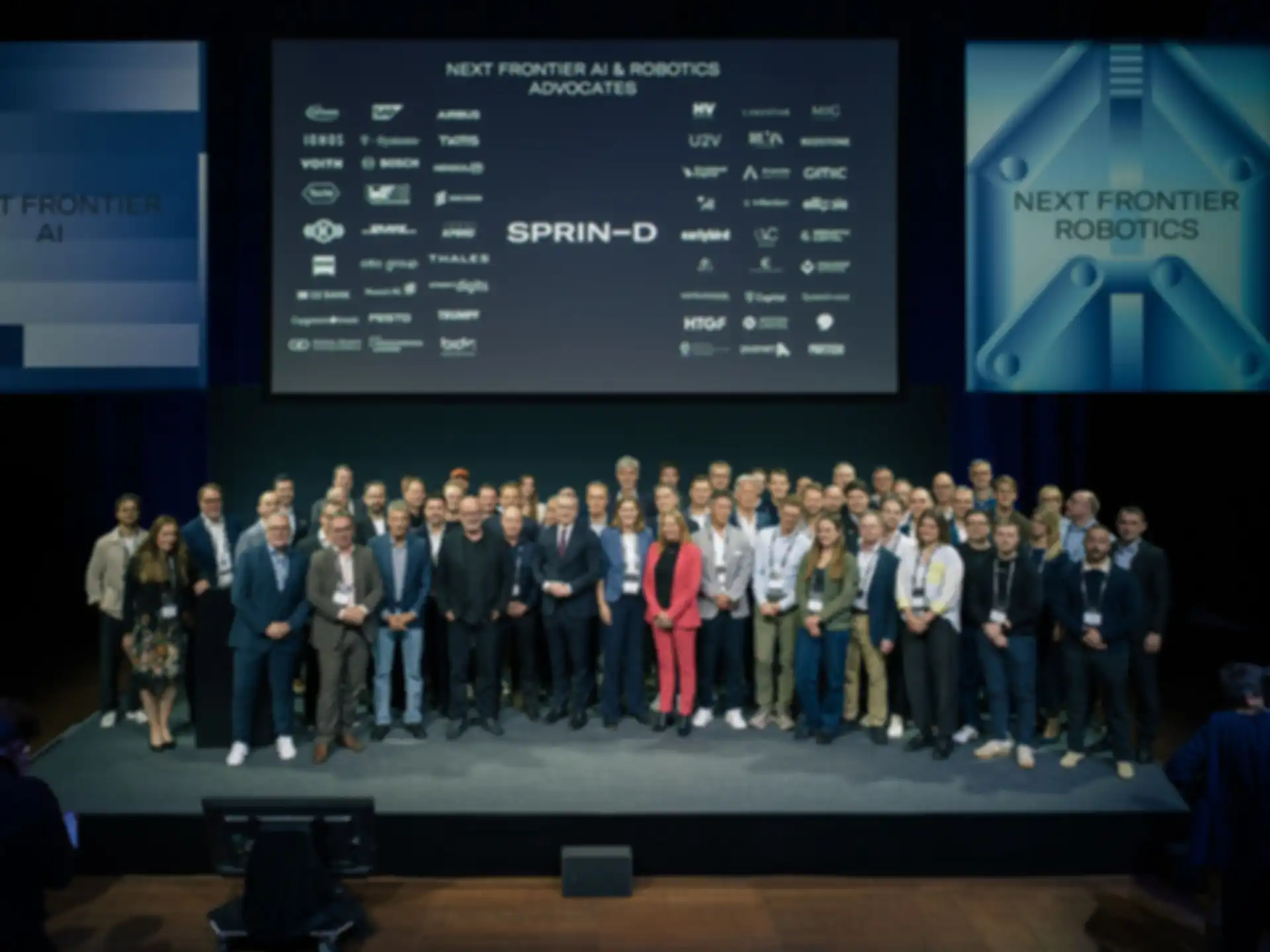
Europe's Industry Joins In

SPRIND launches Corporate Advocates Program for AI and Robotics.

Read More

More Challenges and Funken