3/12/2026
NEW CURRENT COLLECTOR FOR BATTERY CELLS
Battery startup Batene closes five million euros financing round
The startup Batene has closed a financing round of five million euros. Lead investors are the companies of Schwarz Group. Last year, the Federal Agency for Breakthrough Innovation SPRIND financed the company's development work with a startup grant of around one million euros.
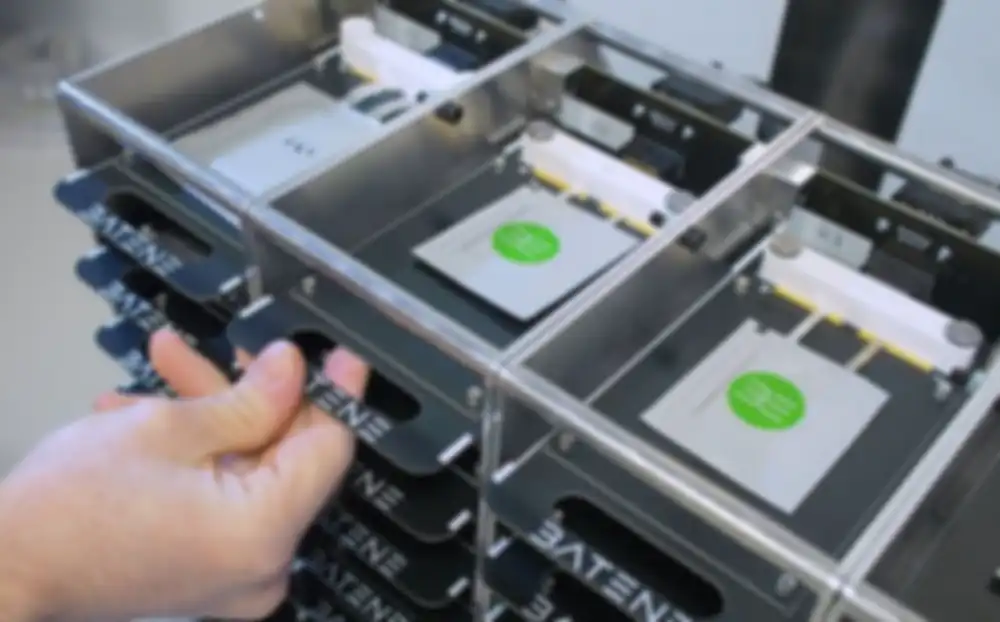
With this investment, Batene is launching the industrial validation of the Batene Fleece™ electrodes for more powerful and more sustainable next‑generation batteries. At the core of the development is a novel three‑dimensional metal‑fleece architecture for current col-lectors in battery cells.
Rafael Laguna de la Vera, Director of SPRIND, on the latest developments in the project supported by SPRIND: Building a competitive European battery manufacturing base takes more than capacity. Those who only catch up remain dependent. Europe needs breakthrough innovations that set its own technological standards — and challenge industry to rethink established approaches. Batene does exactly that.

A new architecture for the current collector
While battery cell chemistry is advancing rapidly, the current collector — a key component of the battery cell — has remained virtually unchanged for decades. Batene has introduced a globally unique approach by replacing conventional copper and aluminium foils with a three‑dimensional metal‑fleece structure. This enables a much faster and more homogeneous distribution of charge carriers, the electrons and lithium ions, within the battery electrode, improves mechanical anchoring of active materials, and opens up new degrees of freedom in process design.
Prof. Dr. Joachim Spatz, Co-founder of Batene GmbH and Director at the Max Planck Institute for Medical Research, explains: The current collector is a structural lever of the battery cell that has hardly been re-thought so far. With our 3D electrodes, we are realising a new architecture in which the performance leap results from the interpenetration of the current collector with the storage material. With industrial validation, we are now setting out to prove that this approach also holds up under real production conditions.
Together with the Batene Fleece, the company has also developed a new fluorine‑free binder suitable for dry‑processing, which keeps the active particles together over many charging cycles. The fluorine‑containing substances currently used as binders are subject to comprehensive regulatory restriction procedures in the European Union and make battery‑recycling processes more difficult. Against this backdrop, the development of alternative material architectures and manufacturing processes is gaining strategic importance for European cell production.
The binder is a key factor in sustainable battery-cell manufacturing. Our newly developed fluorine-free binder technology enables solvent-free processing and addresses a critical requirement for strengthening Europe’s competitiveness in electrode manufacturing,
depicts Prof. Dr. Martin Möller, Co-founder of Batene GmbH.
With the funding from the financing round, Batene is initiating a validation project in cooperation with established players in the battery industry. The aim is to demonstrate the technical and economic performance of Batene Fleece under industrial conditions. Key milestones are planned to be reached by the end of 2026, with completion of validation targeted for mid‑2027. In the long term, Batene aims to license its technology globally.
The companies of Schwarz Group, with a total revenue of over €175 billion in the 2024 fiscal year, cover the full value cycle: from production and retail to recycling and digitalization. This also creates synergies to the industrial battery value chain. For Batene, the investment therefore provides not only financial backing but also access to a highly capable, unique ecosystem with strong execution power.

About Batene
Founded in 2022 as a spin-off from Max Planck Society research, Batene aims to fundamentally rethink material use, production processes and cost structures in battery cell manufacturing. The company introduced Batene Fleece, a novel current-collector architecture for battery cells. In 2024, Batene was honored with the Max-Planck-Startup Award of the Stifterverband. Shareholders include, among others, Max-Planck-Innovation GmbH, Ocean Zero LLC and Christer von der Burg.
More Magazine Articles