7/17/2026
TEN TEAMS SELECTED FOR NEXT FRONTIER AI
SPRIND supports European teams building the next generation of AI
Europe needs its own AI labs that do not just catch up, but break new ground. This is exactly where SPRIND’s Next Frontier AI Challenge comes in. Following a Europe-wide selection process, the ten teams have now been selected. Over the next two years, they will work on creating the foundations for the next generation of artificial intelligence.
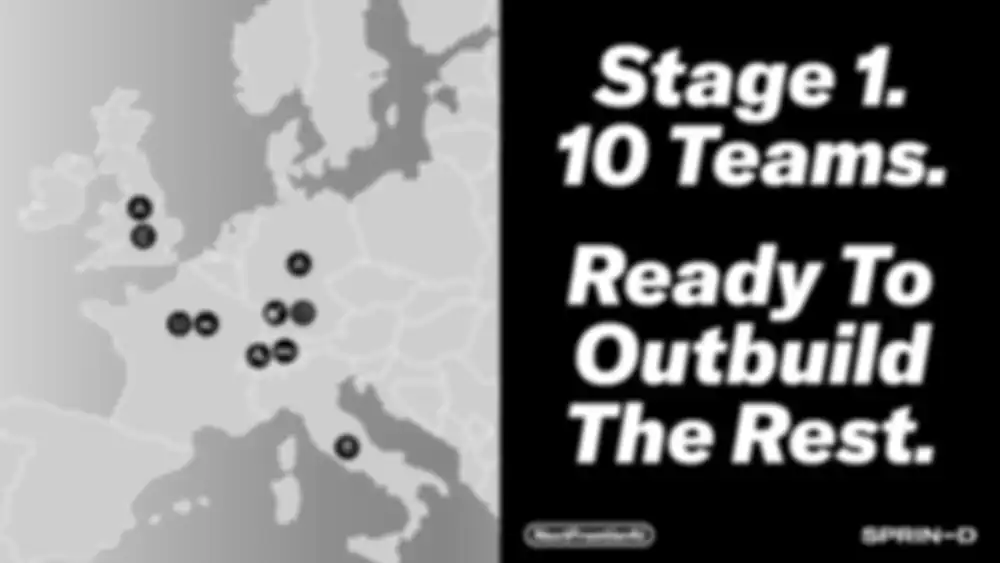
The finalists come from five European countries: Three teams are based in Germany, two each in the United Kingdom, France and Switzerland, and one team in Italy. Among the selected teams are Aionic Labs, UMA, Weight Space Labs, Continuous Intelligence, Paradigma, After Labs, Feyer, and Ontic Labs. Together, they prevailed against applications from more than 30 countries across Europe. They were selected by an international jury of AI researchers, founders and frontier lab veterans. The teams will begin their work this month.
Not catching up – thinking ahead
The Next Frontier AI Challenge has a clear objective: Europe should not simply replicate existing AI systems but develop new technological paradigms. To qualify, teams had to present an approach that promises an improvement of at least one order of magnitude in at least one essential KPI – such as data efficiency, energy consumption or the ability to learn continuously.
The selected teams are pursuing a wide range of approaches. These include Physical AI, from World Models for robotics and Embodied AI to algorithms that can invent industrial hardware. Other teams are developing AI systems for time series that operate directly on live streams of measurements and signals from real-world systems, or pursuing continual learning with systems that adapt their World Models in real time with every interaction. Further teams are working on automating scientific discovery and improving the efficiency of large language models through foundation models trained on the weights of other neural networks rather than on text or images.
The finalists include spinouts from renowned European universities such as Oxford, ETH Zurich, the University of St. Gallen and the University of Tübingen. Several founders previously built AI at companies such as Google DeepMind, OpenAI and Hugging Face – and have now chosen to continue developing their technologies in Europe.
If we simply copy what the leading labs did five years ago, we end up exactly there: five years behind. The interesting question is what the next paradigm looks like, and that question is still open. These ten teams each have a serious answer to it. Now they get the funding and support to test it at speed.
Jano Costard, Head of Challenges at SPRIND.
Europe’s AI future needs more bold bets
The announcement of the finalists comes months after three European AI companies raised the largest early-stage funding rounds the continent has seen. Companies such as AMI Labs, Ineffable Intelligence and Recursive Superintelligence show that major AI investments are possible in Europe.
For SPRIND, this is an important signal – but only the beginning.
Companies like AMI, Recursive, and Ineffable have shattered the myth that Europe can’t raise billion-dollar rounds in AI. But three bets aren’t enough to win. Europe needs thirty of them, with European majorities driving their cap tables. The €125 million we’re deploying is a launchpad, not the endgame. It gives ten exceptional teams the runway to prove their science while keeping the steering wheel firmly in their own hands.
Dr. Johannes Otterbach, Co-Initiator of the Challenge and Investment Advisor AI & Quantum at SPRIND.
Up to €26.5 million in funding per team
The Next Frontier AI Challenge runs for 24 months across three stages. In the first stage, each of the ten teams receives up to €3 million. Following a progress review, up to six teams will advance to the second stage and receive an additional €8 million each. Up to three teams will reach the final stage and receive another €15.5 million each.
All funding is equity-free, and teams are encouraged to attract private investment before, during and after the Challenge. At the end of the Challenge in autumn 2028, SPRIND will support the three winning teams in raising up to €1 billion each from public and private investors to build internationally competitive AI labs.
More about this topic
Challenges and Funken

Next Frontier AI
We are looking for the leap to the next S-curve of artificial intelligence. Disruptive approaches with the potential to fundamentally surpass the capabilities of today's systems.
More Magazine Articles